If you picture Harding as just another New Jersey suburb, you will probably be surprised. Life here is shaped by preserved land, long views, private wells, and roads that still feel connected to the landscape around them. If you are considering a move to Harding or simply want to understand what makes it different, this guide will help you see what country living in Harding really means. Let’s dive in.
Harding feels rural by design
Harding’s country setting is not an accident. Township planning documents show that more than 6,200 acres, or 47.1% of Harding, are preserved open space. Local planning goals focus on protecting rural character, farms, scenic vistas, and bridle trails.
That helps explain why Harding feels different from more typical commuter towns in Morris County. The township has intentionally limited density and preserved large landscapes, rather than growing in a conventional suburban pattern. For you as a buyer, that means the open feel is part of the long-term vision, not just a snapshot of today.
Local documents also point to natural features that shape daily life here. Harding has 44 miles of streams, and water-resource protection plays a major role in land-use planning. That focus supports the larger goal of keeping the township’s countryside setting intact.
Open space shapes the experience
In Harding, preserved land is part of everyday life. Township planning identifies the Great Swamp National Wildlife Refuge, Morristown National Historical Park, Lewis Morris Park, and Loantaka Brook Reservation as central to the township’s character.
The Great Swamp has a particularly strong presence here. According to the township’s open-space plan, close to half of the refuge’s 7,700 acres are in Harding. Morristown National Historical Park also preserves more than 1,300 acres in the township.
Residents have made it clear what they value about this setting. Public comments in the township’s planning process highlighted historic farms, dark skies, bridle trails, and curved roads without curbs. If you are looking for a place where the landscape still takes the lead, Harding fits that description.
Lot sizes are usually measured in acres
One of the biggest differences between Harding and a standard suburb is the scale of the lots. In the R-1 zone, the minimum lot size is three acres. In the RR Rural Residential zone, subdivisions must average five acres per residential lot, with a three-acre minimum lot size.
The township’s land-use plan says the low-density countryside averages 5.2 acres per lot. It also notes that these areas include historic homes, barns, farm buildings, and many lots larger than ten acres. In practical terms, you should expect acreage, not a typical backyard-and-fence layout.
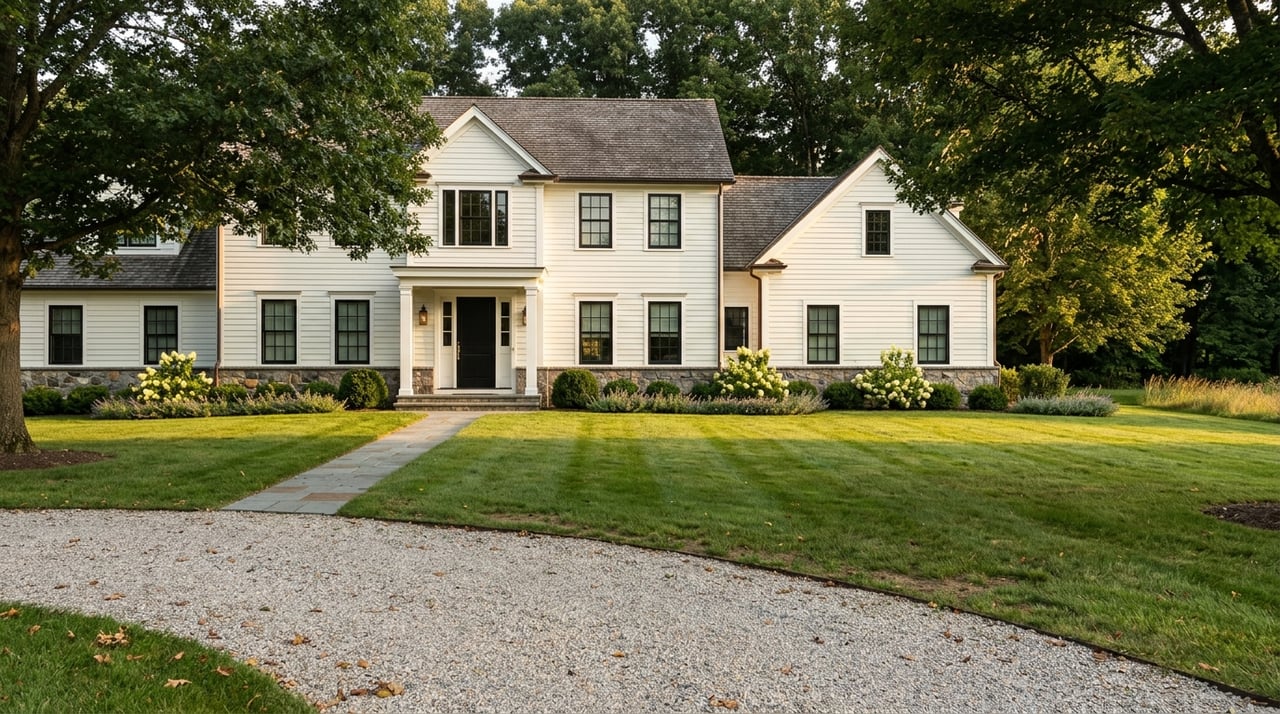
This larger-lot pattern changes how a home lives. You may have a longer driveway, more land to maintain, and more visual privacy. You also may find that neighboring properties feel farther apart, which adds to the sense of quiet and space.
Smaller-lot pockets do exist
Harding is not entirely one type of housing. There are a few areas where homes are clustered more closely together, but these are the exception, not the rule.
The township identifies Harding Green and Shadowbrook in the northwest corner as planned residential pockets. Their location between Routes 202 and I-287, along with access to public water and sewer infrastructure, allowed relatively higher density of up to four units per acre.
So if you want the Harding address and atmosphere but prefer less land to manage, there may be select options that fit. Still, the overall character of the township remains strongly acreage-based and low density.
Wells and septic are part of the picture
Country living in Harding often comes with different infrastructure than you might expect in a more conventional suburb. The 2024 master-plan reexamination says only 233.9 acres are in the Sewer Service Area, and the township does not plan to expand that area beyond what has already been approved or constructed.
The same local planning source says a majority of properties receive water from private wells. That means many homes in Harding operate outside the standard public water and sewer model found in denser towns.
For you, this matters during the home search. A property’s well, septic setup, and site conditions are not side notes here. They are often part of understanding how the home functions day to day and what ownership will involve.
Equestrian culture is woven into the town
In Harding, horses and trails are not just marketing language. The township’s open-space plan points to a long history of equestrian and bridle trails, many of which are still actively used. The plan even recommends protecting them through easements or licenses.
The Open Space Trust Committee’s criteria also specifically include public access, equestrian trails, and hiking. That tells you this is not a minor lifestyle feature. It is part of the township’s identity and preservation priorities.
This can influence what you see in the housing stock too. Some properties include barns, open fields, and pastoral acreage that support an equestrian lifestyle. Even if you are not a rider, that landscape helps define the visual and practical character of Harding.
Farms, fields, and historic landscapes remain visible
Harding’s rural feel is supported by more than zoning alone. The township’s open-space plan says there were more than 1,780 acres of farmland-assessed land as of April 2020. That is a meaningful amount of working or agriculturally assessed land for a commuter-area township.
The land-use plan also highlights areas like Sand Spring Road, Tempe Wick Road, and Lee’s Hill Road for their historic homes, barns, open fields, meadows, and hedgerows. These are the kinds of details that give Harding a true country backdrop rather than a suburban look with larger lawns.
If you are drawn to legacy properties, estate settings, or homes with a stronger connection to land, this is one of the reasons Harding stands out. The scenery is still tied to agricultural and historic patterns that many towns have long since lost.
Daily life balances privacy and access
One of Harding’s strongest advantages is that it offers a country setting without feeling cut off. The township’s land-use plan notes that the Harding Green and Shadowbrook area was shaped in part by its position between Routes 202 and I-287.
The same planning document says this corridor benefits from easy access to Morristown for health and hospital services. New Vernon’s business area is described as compact, mixed-use, and historic, which helps it fit the township’s overall character rather than feeling heavily commercial.
County commute data adds more context. In Harding, 67.5% of workers drove alone, 16.9% worked from home, and 11.6% used public transportation, with a mean travel time to work of 32.4 minutes. For many buyers, that means Harding can offer breathing room at home while still functioning within the broader Morris County commuter network.
What buyers should realistically expect
If you are considering Harding, it helps to come in with the right expectations. This is not the place to look for uniform subdivisions, dense retail corridors, or a standard suburban lot pattern.
Instead, you are more likely to find:
- Large lots with a greater sense of separation
- Preserved open space as part of the everyday setting
- A mix of historic homes, estate-style properties, and a few planned clusters
- Private wells on many properties
- Limited sewer service outside specific pockets
- A lifestyle shaped by trails, fields, and scenic roads
That combination is exactly why Harding appeals to many buyers. It offers a version of country living that is protected by local planning, yet still connected to the wider region.
What country living in Harding really means
The most accurate way to think about Harding is as estate-style country living in a township that has chosen to stay that way. Large preserved tracts, low-density zoning, farmland, bridle trails, and limited infrastructure expansion all work together to protect its identity.
For you, that can mean more privacy, more land, and a stronger relationship to the natural setting around your home. It can also mean understanding property features that are less common in denser towns, from wells to septic systems to larger site upkeep.
If that balance of space, scenery, and long-term preservation is what you are after, Harding offers something increasingly rare in northern New Jersey. And if you want help understanding how a specific property fits into that picture, the Stephanie Mallios Team is here to offer thoughtful, high-touch guidance tailored to your move.
FAQs
What makes Harding feel more rural than other Morris County towns?
- Harding’s rural feel comes from local planning choices that preserve open space, limit density, protect farms and scenic vistas, and support features like bridle trails and large-lot zoning.
Are most homes in Harding on large lots?
- Yes. In much of Harding, minimum lot sizes start at three acres, and the township’s low-density countryside averages 5.2 acres per lot.
Do homes in Harding usually have public water and sewer?
- Not always. The township says only 233.9 acres are in the Sewer Service Area, and a majority of properties receive water from private wells.
Are there any smaller-home communities in Harding?
- Yes. Areas such as Harding Green and Shadowbrook are planned residential pockets with relatively higher density, but they are limited exceptions within a largely acreage-based township.
Is equestrian living a real part of Harding life?
- Yes. Township planning documents describe a long history of equestrian and bridle trails in Harding, and local open-space priorities continue to include equestrian trail access and protection.
Can you still commute easily from Harding?
- Harding offers a country setting with access to the broader Morris County commuter network. County data shows most workers drive, some work from home, and some use public transportation, with a mean commute time of 32.4 minutes.